This guest post is from Anthony Williams - an ardent software architect and engineer. His focus is building applications which improve human lives at scale.
...
Looking to move fast? Keep it simple.
The question: “Is it possible to create a fully functional Android app using almost entirely free-tier software within a single quarter and publish it to the Google Play Store?”
The goal: Utilize the best and newest mobile technologies to help unite marginalized communities with the services they urgently need - ranging from employment, food, and housing assistance all the way to support services for veterans and their families.
Who are we? EEC and Unify
Unify Consulting is a consulting firm headquartered in Washington state that is focused on delivering collaborative solutions, with consultants distributed across the United States. We develop a wide range of products in sectors including healthcare & life sciences, energy & utilities, nonprofits, telecommunications, and more.
In October 2023, Unify met with Sharonne Navas, Co-Founder & Executive Director of the nonprofit organization Equity in Education Coalition of Washington (EEC) to plan our joint delivery of the application. The funding for the project would be provided via grant money from Washington state. Due to the fixed budget, there would be no money for additional features or timeline extensions. Abas Kabato – a visionary tech enthusiast with a deep passion for democratizing and expanding technology access – was managing the process for EEC.
The consulting delivery team of five consisted of a scrum leader, a UX designer, and three engineers – representing backend, mobile/frontend, and quality assurance. The group had no illusions about the difficulty of building a new mobile app from scratch within the limited timeline of three months, nor the impact of helping thousands of individuals easily connect with services that could immediately and significantly improve their lives.
The ConnectWA mobile app
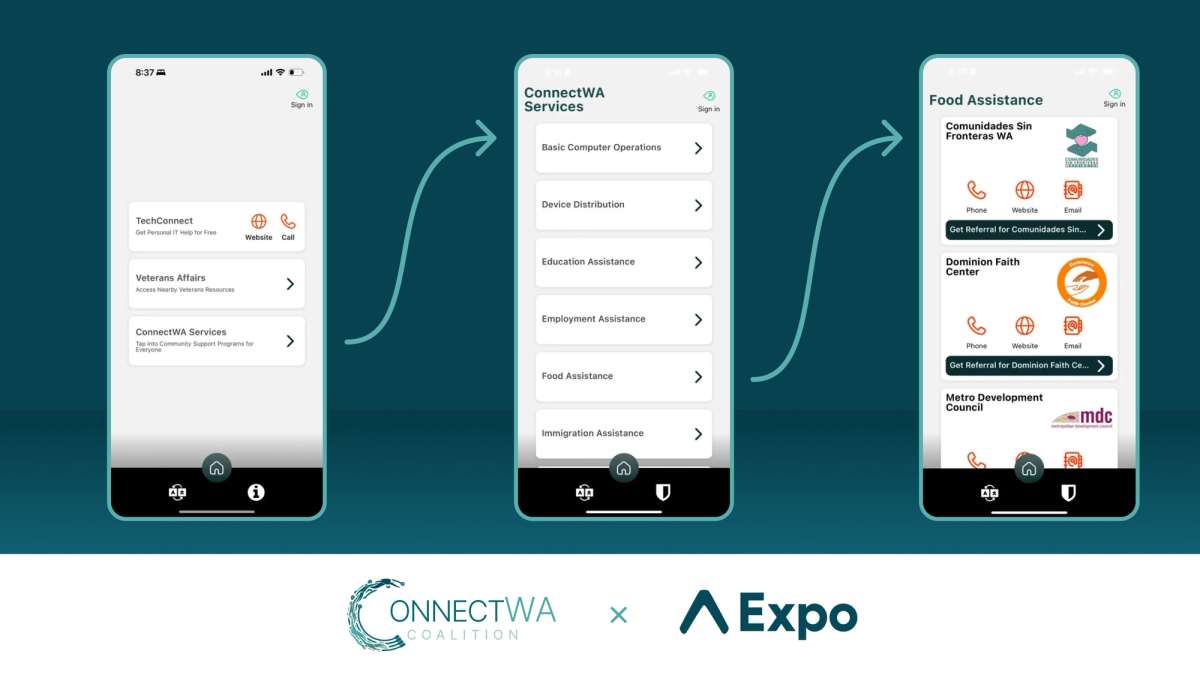
The mobile app, named ConnectWA, is designed to function as a bridge between people who need services in Washington state and various service providers throughout the state, including the Washington State Department of Veterans Affairs (WDVA). This includes services to find shelter, food, and education, the ability to create a referral for those services, as well as to connect directly to a live service desk for support (via TechConnect Washington).
The app features multi-language support for non-English speakers, and a “private” mode that provides access for users with elevated privacy concerns, such as domestic violence survivors and any individuals in unsafe environments.
At its core, the ConnectWA mobile app is designed to be simple, which eliminates many barriers to access for users who may be unfamiliar with technology. The app also aims to keep technical requirements at a minimum, making it maximally compatible and allowing installations on the widest possible set of devices.
Building an Expo app as simply as possible
One of the most difficult pieces of solving problems with technology is selecting the proper technology for each piece of the puzzle. While today’s software ecosystem around app development has a wealth of options, the overarching goals of ConnectWA kept the options meaningfully constrained.
The data for the application was sourced from information provided by the various service providers EEC had partnered with via a simple form, then stored in Azure SQL Database. This data was normalized and uploaded to an instance of a CMS tool named Strapi. Using a CMS tool allowed EEC to manage versioned sets of information (email addresses, phone numbers, website URLs, and even logos), update the data via a simple web UI, provide data access via a simple RESTful API, and even provided tooling to support multiple languages.
For any software needs not provided by Strapi (and to have full control over various integrations with other platforms), the team used AWS, which brought in staples such as CloudWatch, EC2, ECR, S3, and Virtual Private Cloud. To provide the simplest management experience possible, the team created a small web app for EEC administrators using NodeJS and Express, which was hosted in AWS as well.
The final piece of the puzzle came from Expo SDK, which allowed the team to develop a robust mobile app in a single codebase by a single engineer, produce artifacts for internal testing by the rest of the team, and eventually create artifacts to publish the app to the Google Play Store.
Thanks to Expo the effort’s velocity ramped up quickly – the codebase is written in TypeScript and was perfectly straightforward to set up on both Windows and Apple machines. Using Expo’s excellent documentation, several screens (and even entire workflows) were each prototyped within a single day. Following early feedback from EEC, multiple iterations were executed just as swiftly, and the first app build was generated using Expo Application Services (EAS) prior to Halloween ‘23 – less than a month after the effort began. The final build (the one ultimately submitted to the Google Play Store for review) was generated on January 30th, 2024 – for an incredibly nimble total of roughly 100 days.
Expo tools and services used
I could create a more exaustive list of all the expo libraries we used but for the sake of brevity I'll just list the primary tools and services from Expo that were used to build and ship this app:
- Expo CLI
- Expo EAS
- Expo Auth Session
- Expo Config Plugins
- Expo Web Browser
- Expo Build Properties
- Expo Splash Screen
The Future for Unify and ConnectWA
Thanks to the architecture of the app and its supporting services, managing up-to-date information for its users is relatively simple for EEC’s administrators. Over time, they aim to expand the features offered by ConnectWA and incorporate user feedback along the way. The success of the app is measured both in individual needs met and lives improved. For Unify, the firm was able to answer the opening question with a resounding “yes” – thanks to Expo it is entirely possible to develop and publish an app within a quarter using free tier software.